
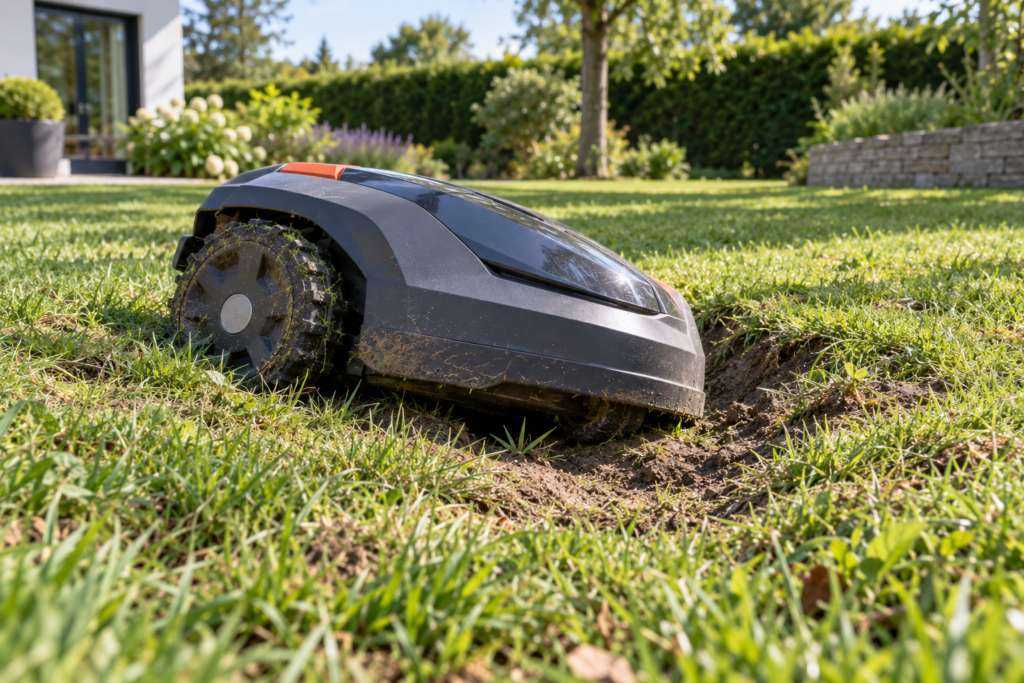
Robot lawn mowers work best on reasonably smooth grass, but real yards are rarely perfectly flat.
Small bumps usually aren’t a problem. The trouble starts when the mower encounters deeper holes, raised ground, soft soil, steep transitions or repeated dips that cause it to lose traction or ground clearance.
If your robot mower keeps getting stuck on uneven ground, don’t immediately assume you need a more powerful mower.
First determine whether the problem is traction, clearance, terrain shape or routing.
Quick diagnosis
| What happens | Likely cause | First check |
|---|---|---|
| Wheels spin but mower doesn’t move | Poor traction | Wet grass, mud and wheel tread |
| Mower rests on the ground | Insufficient clearance | Hole, bump or sharp transition |
| One wheel drops into a hole | Depression/uneven soil | Depth and approach direction |
| Mower stops on a slope | Slope or traction limit | Gradient and surface condition |
| Mower gets stuck only when wet | Soft ground | Drainage and soil |
| Same location causes failures | Local terrain defect | Repair or exclude that area |
| Mower struggles across the whole yard | Mower/terrain mismatch | Chassis, wheels and drivetrain |
| Stops without physical contact | Navigation/sensor problem | Error message and app |
Dreame’s current robot-mower troubleshooting guidance specifically recommends checking for holes, depressions and uneven terrain when a mower repeatedly gets stuck, along with wet grass, obstacles and tall grass.
1. Watch the mower fail before changing anything
The first step is simple: observe what actually happens.
A mower that gets stuck because its wheels are spinning has a different problem from one whose chassis is resting on a bump.
Look for three main failure patterns.
Wheels spinning
The mower still has enough clearance, but the drive wheels cannot generate traction.
This often happens on:
wet grass, loose soil, mud, slopes or worn/clogged tires.
Mower bottoming out
The center or underside of the mower contacts the ground while the wheels partially lose contact.
This is a ground-clearance problem, not primarily a traction problem.
Wheel dropping into a depression
One wheel falls into a hole and the opposite side lifts or loses grip.
The mower may repeatedly reverse and try again without escaping.
Knowing which one is happening prevents you from solving the wrong problem.
2. Check for holes and depressions
Small dips can be more troublesome than large gentle slopes.
Imagine a mower driving across level ground when one drive wheel suddenly drops two or three inches.
The opposite side can lift enough to reduce traction, leaving the mower trapped even though the yard does not look particularly rough.
Dreame specifically identifies holes and depressions as a common reason a robot mower can repeatedly get stuck.
Inspect the exact failure location for:
depressions caused by erosion, animal holes, sunken soil, irrigation damage or wheel tracks.
If it is a simple lawn depression away from major tree roots or utilities, carefully leveling the area may be the easiest solution.
3. Sharp bumps can be worse than gradual hills
A mower may handle a moderate hill perfectly but fail on a small abrupt mound.
Why?
Because slope percentage and terrain transition are different things.
A gradual incline lets all wheels remain in contact with the ground.
A short, sharp bump can cause the mower to:
lift at the front, contact the underside, unload one drive wheel or activate a lift/tilt sensor.
So don’t judge terrain difficulty only by the maximum slope specification printed on the mower.
The shape of the ground matters too.
4. Check whether the mower is high-centered
This is one of the easiest problems to misdiagnose.
When a mower becomes high-centered, its chassis rests on raised ground while the wheels can no longer provide enough force.
You may see the wheels turning normally, which makes it look like a traction failure.
But adding more aggressive tires won’t create more ground clearance.
Look underneath from a safe position after the mower has stopped.
If the chassis is resting on the ground, your options are generally:
smooth the terrain, change the route or use a mower better suited to rough ground.
5. Test the area when the grass is dry
Uneven terrain gets considerably harder when it is wet.
Water can turn a manageable depression into:
mud, soft soil, slippery grass or a wheel rut.
Dreame recommends avoiding wet-grass mowing when repeated sticking occurs because reduced traction can make the problem worse.
Husqvarna similarly notes that obstacles and slopes create more slipping risk in wet conditions.
Run the mower through the same section after several dry hours.
If it crosses successfully, you likely have a surface/traction problem, not simply terrain geometry.
6. Clean the wheels
Before buying accessories, inspect what you already have.
Grass, soil and mud packed into wheel tread can reduce grip substantially.
Husqvarna specifically recommends cleaning grass from robot-mower wheels when improving traction on difficult terrain and slopes.
Clean according to your mower manufacturer’s instructions, then repeat the test.
This is particularly worthwhile if the mower handled the same area earlier in the season.
7. Look for repeated wheel ruts
Sometimes the robot mower creates its own uneven terrain.
If it travels through exactly the same location repeatedly—for example near:
a charging station, transport corridor, narrow passage or boundary turn—it can wear a rut into soft soil.
The rut gets deeper.
Then the mower slips more.
That creates an even deeper rut.
Eventually a location that was originally easy becomes a repeated failure point.
Changing the route or mowing pattern can break this cycle.
8. Change the approach direction
A robot mower may fail crossing an uneven patch in one direction while crossing it easily from another.
Approaching diagonally can allow the wheels to encounter the height difference one at a time instead of simultaneously.
On slopes, Husqvarna currently recommends adjusting mowing-pattern direction and transport paths to improve traction and reduce lawn wear.
If your mower supports configurable patterns or transport paths, experiment before altering the landscape.
9. Uneven ground near a slope is harder
A smooth 20% slope and an uneven 20% slope are not equivalent.
Add:
holes + roots + bumps + wet grass
and the mower may fail well below its advertised maximum slope rating.
Manufacturer slope specifications are usually best treated as limits under suitable conditions, not a guarantee that every irregular section below that number will be trouble-free.
For example, Husqvarna’s own installation guidance emphasizes that obstacles on slopes increase turning and slipping difficulty, particularly when conditions are wet.
10. Don’t confuse slope capability with rough-terrain capability
This distinction will become important when we later recommend products.
A mower rated for a steep slope may still have:
a low chassis, small wheels or poor articulation.
Another mower may handle bumps better despite having a lower maximum gradient.
Some newer rough-terrain mower designs specifically address this with AWD, larger wheels, suspension or traction-control systems.
For example, Navimow currently markets its AWD models for uneven terrain, root-covered ground and raised transitions, while its newer X4 architecture combines four-wheel drive with suspension and traction control. Those are manufacturer claims rather than independent MowerCheck testing, but they illustrate why terrain capability involves more than maximum slope percentage.
11. Check tall or dense grass around the problem
Sometimes the terrain gets blamed when the grass itself is contributing.
Tall grass creates additional resistance around:
wheels, caster assemblies and the mower deck.
Dreame currently recommends shortening grass above about 10 cm before robot mowing when repeated sticking occurs on applicable models.
The exact height limit varies by mower, so follow the manual for your model.
If the lawn has become heavily overgrown, mow it conventionally first and let the robot maintain it afterward.
12. Soft soil can be worse than visible bumps
A lawn can appear flat but still trap a robot mower.
Typical causes include:
recent landscaping, poor drainage, heavy rain, mole activity or thin turf over loose soil.
The mower sinks slightly, increasing rolling resistance.
Its wheels then spin and excavate the area further.
If failures only occur after rain, check drainage before changing mower settings.
13. Repair minor terrain problems carefully
For ordinary lawn depressions without major roots, drainage structures or buried utilities, smoothing the surface can be an effective fix.
The goal is not to create a perfectly flat golf green.
You simply want to eliminate abrupt transitions that:
trap wheels, lift the chassis or cause repeated spinning.
Make gradual transitions rather than replacing one sharp hole with one sharp mound.
For uneven ground around major tree roots, use more caution. Our separate guide explains why reshaping soil or cutting roots around mature trees can create bigger problems:
Robot Mower Gets Stuck on Tree Roots: Causes & Fixes
14. Create a no-go zone when repair isn’t practical
Not every part of the yard needs to be robot-accessible.
If a small location repeatedly traps the mower because it contains:
a deep depression, rocks, severe erosion or terrain that should not be altered, excluding that area may be the most reliable solution.
Dreame recommends using a no-go zone when the mower repeatedly gets trapped in the same location.
Husqvarna similarly recommends stay-out zones for terrain beyond a mower’s capability.
A small manual-trimming area can be preferable to rescuing the mower every day.
15. Watch what happens when the mower turns
Straight-line traction is only part of the problem.
Many terrain failures happen while the mower is turning.
A conventional robot mower may rotate using different wheel speeds. On:
soft soil, slopes or uneven ground
that movement can create wheel spin and grass damage.
If the mower crosses an area perfectly but gets stuck whenever it turns there, try changing:
the mowing pattern, virtual boundary or transport path
so the turn happens on flatter ground.
16. Check the boundary position
The virtual or physical boundary can accidentally force a mower through the worst part of an uneven area.
Moving the boundary several inches may allow the robot to use:
firmer ground or a gentler transition.
This is often easier than modifying the terrain.
For mapped mowers, consider a small stay-out zone around the problem spot.
For wire-based systems, follow the manufacturer’s required boundary distances before repositioning the wire.
17. Sensors can react to uneven ground too
If the mower stops even though it does not appear physically trapped, check the app.
Uneven terrain may trigger:
lift, tilt or obstacle detection.
For example, Dreame documents that its mower may briefly attempt to escape after its lift sensor is triggered by uneven ground, while stopping the cutting disc immediately for safety.
Different manufacturers handle these events differently.
Do not disable safety systems to force the mower through difficult terrain.
18. Navigation can still be part of the problem
If the mower struggles on uneven terrain under:
trees, beside buildings or inside narrow passages,
you may have two problems at once.
The physical ground may be difficult while satellite positioning is also poor.
Check the app error before assuming every stop is mechanical.
For satellite-navigation issues, see:
Robot Mower Losing RTK or GPS Signal? How to Find the Cause
19. When better wheels can help
Traction accessories may help when the mower has adequate ground clearance but loses grip.
They are most relevant for:
moderate slopes, slippery grass and loose soil.
They are much less useful if the mower:
bottoms out, drops deeply into holes or physically cannot clear a raised obstacle.
Husqvarna, for example, offers Terrain Kits for compatible models to improve grip on difficult slopes.
Diagnose first, accessorize second.
20. When the mower may simply be the wrong design
A single rough patch usually doesn’t justify replacing a mower.
But if a large portion of the property has:
deep undulations, steep terrain, ruts, roots and soft ground,
the mower’s physical design becomes a major buying factor.
Pay attention to:
wheel size, ground clearance, drivetrain, AWD, suspension, slope capability and traction control.
Do not choose purely by acreage.
Five-step troubleshooting sequence
Use this order before making major changes.
1. Observe the failure. Determine whether the mower is slipping, bottoming out, dropping into a hole or stopping because of a sensor/navigation issue.
2. Clean the wheels and test on dry grass. This eliminates two common traction variables.
3. Inspect the ground. Check for depressions, ruts, sharp bumps and soft soil.
4. Change the route. Adjust the mowing direction, transport path or boundary where possible.
5. Repair or exclude the location. Smooth minor lawn defects where appropriate, or create a no-go zone when the terrain should not be changed.
When should you consider a rough-terrain mower?
A different mower becomes worth considering when difficult terrain is a property characteristic rather than one isolated defect.
For example, if your yard contains extensive:
rolling ground, severe slopes, exposed roots and irregular transitions,
features such as AWD and terrain-adaptive suspension may provide real benefits.
Newer mower designs are increasingly addressing these conditions directly. Current Navimow models, for example, advertise AWD, terrain tires and stability systems specifically for uneven ground, roots and slopes.
We would still verify actual US models and availability before recommending them commercially.
FAQ
Can robot lawn mowers handle uneven ground?
Yes, within limits.
Most robot mowers can handle normal lawn irregularities. Deep holes, sharp bumps, soft soil and abrupt height changes are considerably harder.
Why does my robot mower keep getting stuck in small holes?
A drive wheel may drop far enough that another wheel loses traction or the mower chassis contacts the ground.
Smoothing the depression or changing the route often helps.
Will bigger wheels help on uneven terrain?
They can improve obstacle crossing and traction, but wheel size does not solve every problem.
Ground clearance, weight distribution and drivetrain design also matter.
Is AWD better for uneven ground?
AWD can improve traction and control on challenging terrain, especially when slopes are involved.
It cannot compensate for every deep hole or obstacle, so terrain still needs to remain within the mower’s physical limits.
Should I fill holes in my lawn?
Minor lawn depressions can often be leveled carefully.
Be more cautious around major tree roots, drainage systems, irrigation and buried utilities.
Why does my mower get stuck only after rain?
Wet grass and soft soil reduce traction.
A wheel that normally crosses a depression may sink or spin when the ground becomes saturated.
Can I create a no-go zone around uneven terrain?
Yes, on compatible mapped systems.
If one small area causes repeated failures and isn’t practical to repair, a no-go or stay-out zone can be one of the most reliable solutions.
Does a high slope rating mean a mower is good on rough ground?
Not necessarily.
Slope capability describes incline performance. Rough-terrain performance also depends on ground clearance, wheel size, chassis geometry, suspension and traction.
Final checklist
Before blaming the mower, verify that the wheels are clean, the grass is reasonably dry, the mower isn’t bottoming out, obvious holes and ruts have been inspected, the route isn’t forcing the mower through the worst spot, and any sensor or navigation errors have been checked.
If one isolated area remains troublesome, repair or exclude that area.
If rough terrain affects a large portion of the property, then mower design becomes part of the solution.
The goal isn’t to make every inch of the yard perfectly flat. It’s to give the mower a route where its wheels stay planted, its chassis stays clear and its traction remains predictable.