
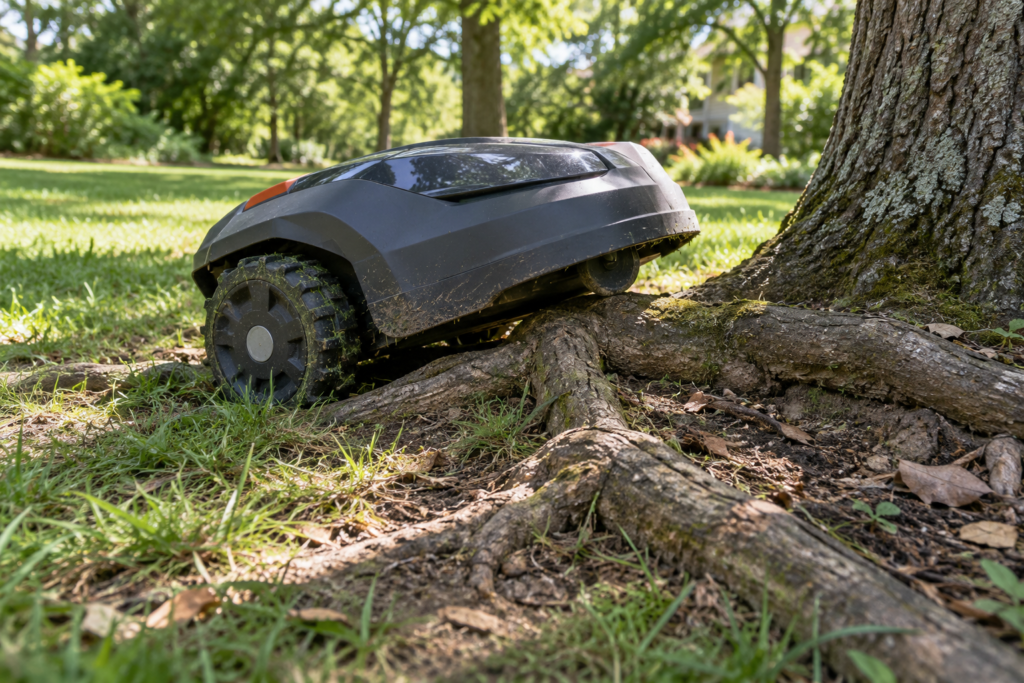
A robot mower getting stuck around a tree does not automatically mean the mower is defective.
Exposed roots can create several different problems at once:
- wheels lose traction
- the mower bottoms out on a raised root
- one wheel lifts off the ground
- the mower repeatedly turns into the same obstacle
- a narrow route becomes too difficult to cross
- satellite navigation becomes less reliable beneath the canopy
The important question is:
Is this a fixable yard or setup problem, or is the terrain simply beyond what the mower is designed to handle?
Start by identifying exactly how the mower gets stuck before changing the yard or buying accessories.
Quick diagnosis
| What happens | Likely cause | First thing to check |
|---|---|---|
| Wheels spin beside the root | Poor traction | Grass, mud and wheel condition |
| Mower rests on root with wheels free | Insufficient ground clearance | Height of exposed root |
| One side lifts up | Uneven terrain | Root position and approach angle |
| Stops before touching root | Navigation/sensor issue | Error message and virtual boundary |
| Gets stuck only when wet | Traction problem | Soil and grass conditions |
| Same root causes repeated failures | Route/boundary problem | Exclude or reroute the area |
| Problems happen mainly under canopy | Navigation may contribute | Test same area with better sky visibility |
| Mower crosses roots but damages lawn | Repeated wheel slip | Route direction and ground condition |
1. First determine how the mower is getting stuck
Don’t immediately move the boundary or cover the roots with soil.
Watch the mower approach the problem area.
There are four common failure patterns.
The wheels spin
The mower still has ground clearance, but it cannot generate enough traction.
Typical causes include:
- wet grass
- loose soil
- mud
- leaves
- smooth or clogged wheels
- approaching the root sideways
Cleaning clogged wheels can improve traction, and manufacturers such as Husqvarna specifically recommend keeping wheels clear of accumulated grass when traction becomes difficult.
The mower becomes high-centered
This happens when the chassis rests on the root while the drive wheels lose enough contact with the ground that they cannot move the mower.
In that case, more aggressive tires may not solve the underlying problem.
The limiting factor is ground clearance and mower geometry.
One wheel climbs the root and the mower tilts
A large exposed root can act like a small curb.
One wheel climbs it while another loses traction, causing:
- spinning
- repeated reversing
- lift/tilt warnings
- unsuccessful turns
This is particularly common where multiple roots create an irregular surface.
The mower stops without physically getting stuck
Then the root may not be the primary problem at all.
Possible causes include:
- obstacle detection
- virtual-boundary behavior
- RTK/GPS loss
- camera or LiDAR interpretation
- lift/tilt sensor activation
Check the error message before changing anything.
2. Test the same area when the lawn is dry
A root that causes no trouble on a dry afternoon may become a serious obstacle after rain.
Shaded areas beneath trees often stay wet longer because they receive less direct sunlight.
Wet conditions can reduce traction around:
- exposed roots
- bare soil
- leaves
- slopes
Manufacturers also recognize that obstacles combined with slopes can increase slipping, particularly in wet conditions.
Run the mower through the same spot when the ground is dry.
If the problem disappears, you probably have a traction problem, not a navigation or clearance problem.
3. Clean the wheels before changing the yard
This should be one of the first checks.
Grass and soil packed into the wheel tread can significantly reduce grip.
With the mower safely switched off according to the manufacturer’s instructions:
- inspect the drive wheels
- remove accumulated grass
- remove mud
- check for damaged or excessively worn tread
- inspect freely rotating front/caster wheels where applicable
Do not assume that wheel slip automatically means the mower needs aftermarket traction accessories.
Start with the simplest cause.
4. Check whether the mower is bottoming out
Observe the underside while the mower crosses the root from a safe distance.
If the chassis touches the root before the wheels lose traction, the root may simply exceed the mower’s practical ground clearance.
Signs include:
- scraping beneath the mower
- wheels spinning while the chassis remains stationary
- repeated lift warnings
- mower rocking over the obstacle
- visible contact marks underneath
If this happens consistently, changing navigation settings will not fix it.
You need to change the route, the terrain, or ultimately the mower type.
5. Try changing the approach direction
A mower may fail when crossing a root at 90 degrees but succeed when approaching it diagonally.
Why?
Because the wheels encounter the height change at different times.
Instead of both sides suddenly climbing the same obstacle, one wheel can climb first while the others maintain traction.
This does not mean you should force the mower over a root that is clearly too large.
But if your mower supports:
- mowing-pattern direction
- transport paths
- virtual corridors
- zone-specific patterns
changing the approach angle can sometimes solve repeated sticking.
Husqvarna, for example, recommends adjusting mowing and transport-path direction in difficult sloped areas to improve traction and reduce grass damage.
6. Move the virtual boundary away from the root
For a wire-free mower, this can be the cleanest solution.
If one exposed root repeatedly traps the mower, there is usually little benefit in making the robot attempt it every day.
Move the virtual boundary enough that the mower:
- doesn’t climb the root
- still cuts reasonably close to the tree
- has enough room to turn
- doesn’t repeatedly drive across vulnerable soil
Leaving a small manual-trimming area is often better than rescuing the robot several times per week.
7. Create a no-go or stay-out zone
If the difficult area is localized, exclude it.
This works particularly well around:
- clusters of exposed roots
- tree trunks
- decorative stones
- erosion areas
- very steep patches
Manufacturers already recommend stay-out zones where terrain or obstacles exceed what the mower can reliably handle.
A small exclusion area is not a failure.
It is often the most reliable setup.
8. Don’t cut major tree roots just to make the mower pass
This is important.
Exposed roots may be inconvenient for the mower, but they are part of the tree.
Cutting substantial roots can:
- injure the tree
- create disease or pest entry points
- affect stability
- damage long-term health
Penn State Extension specifically warns against cutting exposed roots and recommends minimizing disturbance around mature tree root systems.
If a major root creates a permanent obstacle, it is usually better to:
change the mower route rather than change the tree.
For significant root work, consult a qualified arborist.
9. Don’t simply bury exposed roots with a thick layer of soil
This is another tempting fix:
“I’ll just put soil over the roots until the lawn is level.”
Be careful.
Tree roots need oxygen, and changing soil depth around mature trees can harm the root system.
Penn State Extension warns that adding substantial amounts of soil or compost over roots can reduce essential gas exchange and advises against burying the root flare or heavily covering exposed roots.
So don’t dump several inches of topsoil over a root system simply to create a smoother robot-mower path.
10. What about adding a small amount of soil?
Minor surface irregularities are different from burying major structural roots.
For a shallow depression between roots, careful grading may sometimes improve the mower’s path.
But avoid:
- burying the trunk flare
- piling soil against the trunk
- damaging roots with tools
- compacting the root zone with heavy equipment
- creating drainage problems
Penn State’s guidance for mature trees favors working with the existing root conditions rather than heavily altering them.
When in doubt, rerouting the mower is safer.
11. Roots near a boundary are especially difficult
Imagine this:
tree trunk → exposed root → lawn boundary
If the mower has very little room between the root and the boundary, it may be forced into an awkward turn.
The mower could:
- approach the boundary
- turn
- place one wheel on the root
- lose traction
- reverse
- repeat
The problem isn’t necessarily the size of the root.
It may be the lack of turning space.
Try moving the virtual boundary or physical wire farther from the obstacle where installation rules allow it.
12. Narrow passages make roots harder
A root in an open lawn can often be avoided.
The same root in a 3-foot-wide side passage can become a major obstacle because the mower has fewer alternative paths.
Check:
- passage width
- turning radius
- boundary location
- transport path
- root height
- nearby wall or fence
If the passage is barely wide enough under ideal conditions, adding exposed roots makes reliability much harder.
13. Tree canopy can create a second problem at the same location
Sometimes the mower appears to be “getting stuck on roots,” but two problems are occurring together:
Problem 1: difficult physical terrain
Problem 2: poor satellite positioning under the tree
For RTK/GNSS-based systems, dense canopy can weaken satellite reception.
That can result in:
- stopping
- uncertain position
- poor route behavior
- repeated recovery attempts
Some modern systems use cameras or other local sensors to continue temporarily when satellite coverage becomes limited. Husqvarna, for example, documents AI vision on applicable models as a way to continue mowing for a limited distance when satellite coverage is lost, provided the mower can identify grass.
If your mower loses positioning beneath trees, read:
Robot Mower Loses Signal Under Trees? What Actually Helps
14. How to tell terrain trouble from navigation trouble
Run this simple test.
Test 1: Watch the wheels
If they spin while the mower stays in place:
traction or clearance problem
Test 2: Check the underside
If the chassis is resting on the root:
ground-clearance problem
Test 3: Check the app/error message
If you see:
- positioning error
- poor satellite signal
- outside work area
- navigation error
investigate navigation before changing the terrain.
Test 4: Move the mower manually past the root
If it immediately resumes normal mowing:
the root area itself is probably the problem.
If it continues struggling beneath the tree:
navigation may also be involved.
15. Check for loose soil beside the roots
A mower may clear the root itself but sink beside it.
Rain and erosion can remove soil from around tree roots, creating depressions.
The wheel drops into the low area while the mower chassis or opposite wheel rests on the root.
Look for:
- wheel-shaped depressions
- loose dirt
- repeated wheel marks
- mud
- erosion channels
In some cases the low spot, not the root height, causes the problem.
Any landscaping changes around important tree roots should still be conservative.
16. Fallen leaves can reduce traction
Tree areas naturally accumulate more debris.
A layer of dry or wet leaves can cause:
- wheel slip
- hidden roots
- poor edge detection
- blocked caster wheels
- additional obstacle detection
Remove heavy leaf accumulation from problem routes and test again.
This is particularly useful before concluding that the mower itself is unsuitable.
17. Don’t repeatedly let the mower dig holes
If the mower fails in the same place every day, don’t leave it indefinitely hoping it will eventually succeed.
Repeated wheel spin can:
- damage grass
- loosen soil
- deepen depressions
- expose additional roots
- make the original problem worse
Once you identify a repeat failure point, either correct the route or exclude the area.
18. Could better tires solve it?
Possibly—but only for certain failures.
Traction-focused wheels or manufacturer terrain accessories can help when:
- wheels are slipping
- terrain is soft
- moderate slopes are involved
They are unlikely to solve:
- chassis bottoming out
- a root taller than practical ground clearance
- satellite-signal loss
- inadequate turning space
- an impossible narrow passage
Husqvarna, for example, offers terrain-oriented wheel accessories for certain models specifically to improve grip on difficult slopes.
Use accessories to solve a diagnosed traction problem, not as the first response to every stuck mower.
19. When should you exclude the root area permanently?
A stay-out zone is probably the best solution if:
- the same root traps the mower repeatedly
- the mower bottoms out
- the tree should not be disturbed
- repeated wheel spinning damages the lawn
- the area is too narrow to reroute
- the slope around the root is also difficult
You’ll lose a small amount of automated mowing area, but gain reliability.
A few seconds with a string trimmer occasionally may be much easier than rescuing the mower every day.
20. When is the mower itself the wrong fit?
Sometimes the yard modification required to accommodate the mower becomes unreasonable.
A different mower design may make sense when your property has many areas with:
- large exposed roots
- rough terrain
- steep slopes
- persistent mud
- repeated traction loss
- significant height changes
In that situation, look beyond acreage.
Important mower characteristics may include:
- ground clearance
- wheel size
- drivetrain
- all-wheel drive
- slope rating
- local navigation
- obstacle handling
A mower optimized for a flat suburban lawn may simply be the wrong machine for a wooded, uneven property.
21. A five-step fix sequence
If your robot mower gets stuck on tree roots, use this order:
Step 1 — Clean and inspect the wheels
Remove mud, leaves and grass.
Step 2 — Observe one failure
Determine whether it is:
traction, clearance, navigation or turning space.
Step 3 — Test dry conditions
See whether moisture is a major factor.
Step 4 — Adjust the route
Move the virtual boundary, transport path or mowing direction where possible.
Step 5 — Exclude the area
If the root is still a repeat trap, create a no-go zone rather than damaging the tree.
Common mistakes
Avoid these responses:
- cutting major tree roots
- covering roots with a thick layer of soil
- buying aggressive wheels before diagnosing the problem
- repeatedly restarting the mower in the same location
- assuming every stop beneath a tree is caused by the root
- ignoring RTK/GPS signal conditions
- forcing the mower through an unsuitable narrow passage
- allowing repeated wheel spin to destroy the lawn
When should you contact support?
Contact the mower manufacturer or dealer if:
- the mower reports repeated lift/tilt errors on reasonably flat ground
- wheels don’t drive normally
- one motor appears weaker than the other
- the mower stops in open areas as well
- sensors behave unpredictably
- the mower becomes trapped without an obvious physical cause
A manufacturer such as Husqvarna defines a “Trapped” condition around obstacles as something that should first be handled by freeing the mower, removing the obstacle and restarting it; persistent unexplained problems warrant further troubleshooting.
FAQ
Why does my robot mower keep getting stuck on tree roots?
The most common reasons are insufficient ground clearance, poor traction, uneven terrain or too little room to turn around the root.
Navigation problems under dense tree cover can sometimes occur at the same time.
Should I cover exposed roots with soil?
Not as a general mower fix.
Adding substantial soil over mature tree roots can reduce oxygen exchange and harm the tree. Avoid burying the trunk flare or heavily covering major roots.
Can I cut roots that block my robot mower?
Cutting significant tree roots just to create a mower path is not recommended.
It can injure the tree and potentially affect stability. Consider rerouting the mower or consulting an arborist instead.
Will better robot mower wheels help with roots?
They may help if the problem is wheel slip.
They won’t increase chassis clearance or solve a root that physically lifts the mower off the ground.
Should I create a no-go zone around a tree?
Yes, if exposed roots repeatedly trap the mower.
A small excluded area is often the simplest and safest solution.
Why does my mower only get stuck near trees when it rains?
Wet grass, leaves and soft shaded soil can reduce traction.
Test the location again after the ground dries.
Can RTK signal loss look like the mower is stuck?
Yes.
A mower beneath dense canopy may stop because positioning is unreliable even when it isn’t physically trapped.
See:
Robot Mower Losing RTK or GPS Signal? How to Find the Cause
Are AWD robot mowers better around roots?
All-wheel drive can improve traction and rough-terrain capability, but it does not make large exposed roots disappear.
Ground clearance, geometry and navigation still matter.
Final checklist
Before changing anything around the tree, check:
- Wheels are clean
- Ground is reasonably dry
- Mower isn’t bottoming out
- No wheel is being lifted by the root
- There is enough room to turn
- Boundary isn’t forcing the mower across the root
- Leaves and debris are removed
- Navigation errors are checked
- RTK/GPS performance under the canopy is considered
- Repeated wheel spin isn’t damaging the lawn
- Major roots won’t be cut
- Roots won’t be buried with excessive soil
- No-go zone has been considered
A tree root does not always need to be “fixed.”
Often the better solution is simply to stop making the mower cross it.
Diagnose the failure first. Protect the tree second. Then adjust the mower’s route rather than forcing the terrain to fit the robot.